
Have you ever felt anxious seeing your car’s body or undercarriage turned white after driving on winter roads?
Leaving “road salt (de-icing agents)” attached to your car is a major risk directly linked to rust on your beloved vehicle.
“Washing it every time is a hassle, but I absolutely hate letting it rust.”
Isn’t this a worry that many drivers share?
Calcium chloride has properties that severely corrode iron, eating away at undercarriage parts before you even notice.
However, going to the car wash every day isn’t realistic.
In this article, we will explain the appropriate car wash frequency during the road salt season based on three criteria.
Let’s look together at how to protect your car in a way you can sustain without overworking yourself.
【Conclusion】 Decide Car Wash Frequency Based on 3 Concepts
![[Conclusion] Decide car wash frequency based on three concepts](https://garageredline-style.jp/wp-content/uploads/2026/01/snow-1281636_1280-1024x549.jpg)
What is the Ideal Car Wash Frequency?
- “Immediate washing” is the basic rule after driving on salted roads
- The risk of rust accelerates the longer you leave it
To give you the conclusion first, the ideal frequency to protect your car from rust is “every time you drive on a road where road salt has been spread.”
Attached salt absorbs moisture from the air and transforms into a powerful cause of rust.
Therefore, washing it off on the same day you drive on snowy or frozen roads, or at the latest the next day, is the chemically correct answer.
Especially after driving on highways, fine salt particles have penetrated deep into the gaps of the body and the undercarriage.
The longer it is left, the higher the risk that it will penetrate through gaps and induce rust.
However, heading to a car wash after every daily commute or shopping trip isn’t realistic.
First, knowing the fact that “washing after every drive is best” is the first step in being conscious about protecting your car.
While using this ideal as a baseline, you need to adjust it to fit your lifestyle.
Deciding a Frequency Within a Realistic Range
- Base it on once a week, or when refueling
- Discard “perfection” and prioritize continuity
Knowing the ideal, let’s set “once a week” or “at the timing of refueling” as a practical guideline.
It is difficult to secure time every day amidst busy work and housework, and forcing a car wash on days below freezing can invite trouble like the body freezing over.
The important thing is not to leave dirt for a long period.
A cycle where you only lightly worry about dirt on weekdays and thoroughly rinse it off with a high-pressure washer on weekends is sufficient.
Since road salt is easiest to remove immediately after attachment, it is crucial to take action before it completely hardens and adheres.
Rather than making washing itself a burden due to the pressure of “I must do it every time,” maintaining a pace you can manage is the secret to keeping your car clean for a long time.
Minimum Frequency You Should Stick To
- Reset dirt at least once a month without fail
- Before temperatures rise is the deadline for rust prevention
No matter how busy you are, “once a month” is the line you want to defend at all costs.
Calcium chloride sticks to iron parts like suspension arms where anti-rust paint is thin, or mufflers that get hot, progressing corrosion from places you can’t see.
Especially dangerous are the “warm days” that suddenly visit during winter.
When temperatures rise, chemical reactions are promoted, and the speed of rust progression on undercarriage metal parts accelerates rapidly.
Even if weekend care is difficult, try to visit a car wash on days when temperatures go above freezing or immediately after roads become dirty from melting snow.
Just setting “a monthly reset” as a minimum condition will make a big difference in the state of your undercarriage when spring arrives.
If Preventing Rust, Focus on Flushing the Undercarriage
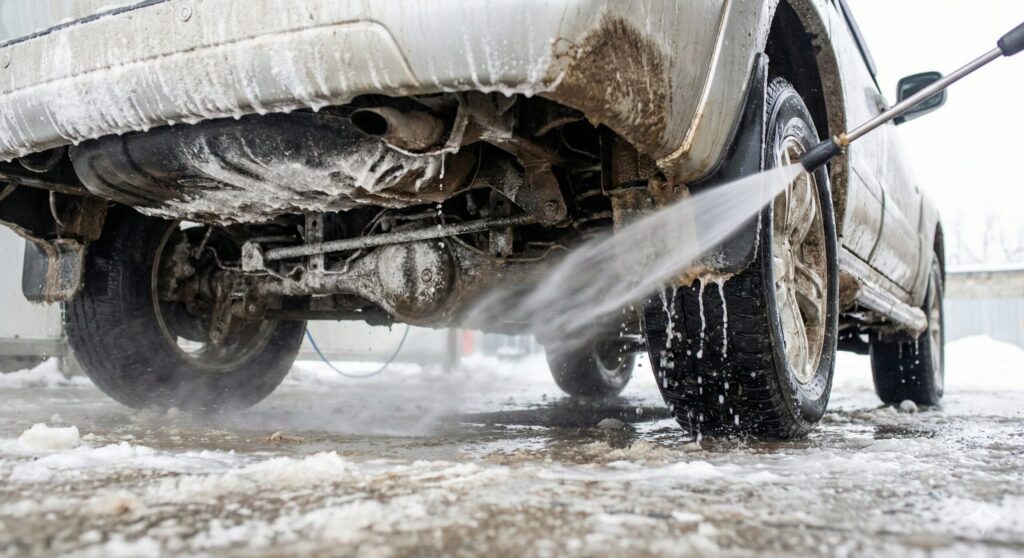
Why the Undercarriage is Prone to Dirt
- Unlike exterior panels, the undercarriage has a lot of exposed iron
- Salt water kicked up by tires attaches directly
In winter car washing, your main focus shouldn’t be the shine of the body.
Above all, thoroughly washing the “undercarriage” is the key to extending your car’s lifespan.
The “salt water” kicked up by tires on snowy roads sticks to the underside of the vehicle with more force than you might imagine.
Exterior panels like bonnets and doors are protected by multiple layers of paint and coating.
On the other hand, suspension parts like mufflers and arms are easily scratched by flying stones, leaving exposed iron constantly threatened by rust.
It is no exaggeration to say that even if the body remains dirty, as long as you keep the undercarriage clean, you can prevent fatal corrosion troubles.
Is it Okay to Just Pressure Spray the Undercarriage?
- When short on time, focusing solely on the undercarriage is fine
- Avoid splashing water on the body as it causes water spots
In conclusion, the method of flushing only the undercarriage with a high-pressure spray is a very effective time-saving technique.
However, you must be careful with the nozzle direction so that spray water does not scatter onto the body.
This is because, depending on the car wash, the water used may contain a lot of minerals.
If water droplets containing minerals attach to the painted surface and dry naturally, they can cause stubborn stains or worsen the water repellency of your coating.
Car Wash Frequency Guidelines Based on How You Drive

Guidelines for Those Who Drive on Snow Daily
- Basically aim for a “Once a Week” reset
- Be careful of road water melted by de-icing agents
If you drive on snowy roads daily, the ideal car wash span is “once a week.”
You want to be especially careful on days when the snow on the road has melted into a “slushy” state.
Snow melted by the effect of de-icing agents becomes water heavily laden with salt, which is scattered to every corner of the vehicle body by the rotation of the tires.
It can be said that the risk of rust is significantly higher after driving on these “wet roads” than driving on dry winter roads.
You don’t need to wash it every time you drive, but please try to form a habit of washing off the week’s accumulated dirt on your days off.
Guidelines for Those Who Can Only Wash on Weekends
- Don’t worry about weekday dirt; ensure a thorough reset on weekends
- Prioritize “Consistency” above all
If washing your car on weekdays is difficult due to work, you don’t need to feel guilty about spending a few days with dirt on your car.
Rust doesn’t cause fatal damage in just a few days; if you thoroughly wash off the salt on the weekend, you can sufficiently protect your car.
What is important is to try not to break the “once a week cycle” as much as possible, whether using a machine or hand washing.
Rather than forcing a wash on weekdays, reliably resetting the dirt on holidays in a way that is easy for you is more likely to be sustainable in the long run.
As long as you keep the rule to “definitely wash it next weekend,” there is no need to worry excessively even if there is a 5-day period of neglect.
Guidelines for Those Who Mainly Drive Short Distances
- Even with low mileage, kicked-up dirt will attach
- Decide washing timing based on “days driven”
You cannot let your guard down just because your main use is short-distance travel like neighborhood shopping or pick-ups.
Even with a drive of just a few kilometers, if you drive on a road spread with road salt, your tires will definitely kick up salt and attach it to the vehicle body.
Regardless of distance, “whether you drove on road salt” is what matters.
Even if it doesn’t look very dirty, attached trace amounts of salt will erode paint and iron over time.
If your mileage is low, try managing it based on dates, such as “the weekend after driving on snowy roads,” rather than “after driving XX km.”
Do not procrastinate thinking “I haven’t driven much so it’s fine,” but periodically washing off dirt is the secret to keeping it clean for a long time.
Tool Selection to Lower the Hurdle of Winter Car Washing
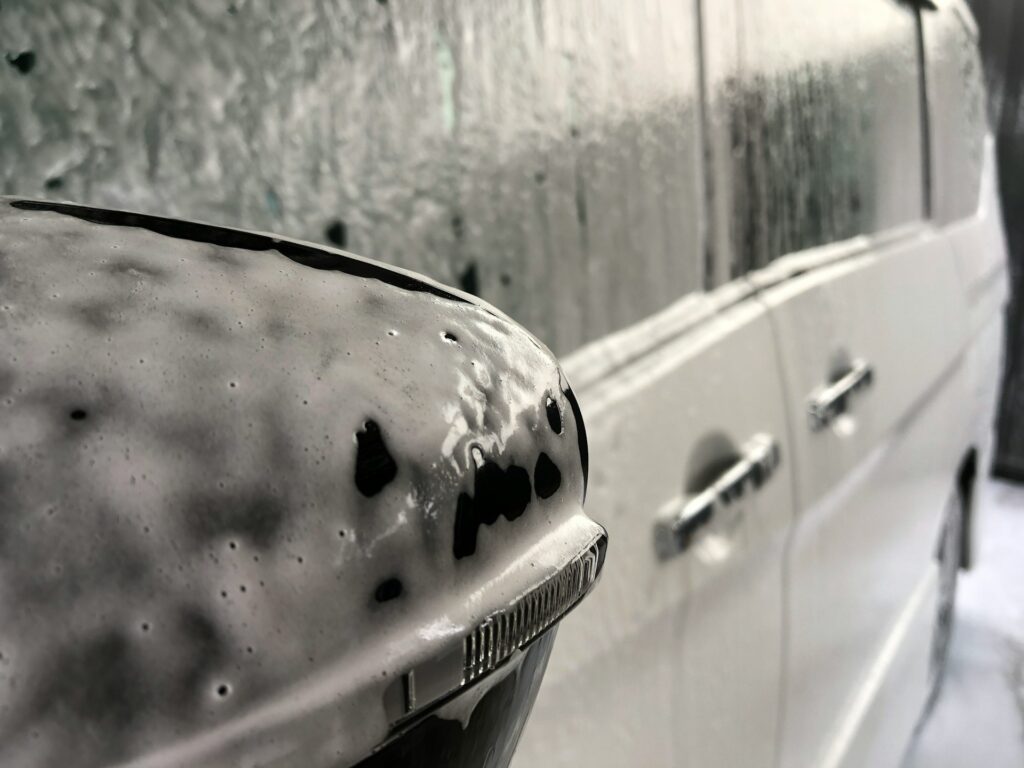
Here are recommended car wash tools for those who prefer to wash their cars themselves.
Choose Car Shampoo Based on pH Neutrality
We recommend a “Neutral” type for the shampoo used in car washing.
While acidic or alkaline detergents are strong against specific dirt, they carry the risk of causing stains or corrosion on metal parts if used incorrectly.
“KeePer PRO SHOP Car Shampoo” is designed not to damage coating layers, gently lifting and removing only surface dirt.
In the cold season when hands get numb, rinsing residue inevitably happens more easily.
Choosing a neutral type, which has little effect on the paint even if some foam remains, will be a source of peace of mind for protecting your car.
Ensure Ease of Washing with a Handled Sponge
In winter car washing, the coldness of your hands is the greatest enemy and a cause for sloppy work.
We recommend a handled type sponge like “Soft99 Rich & Soft Grip.”
The reality of winter is that even if you start washing with hot water, the outside air quickly turns it into cold water.
Even then, with a handled sponge, you don’t need to keep your fingertips submerged in the rapidly cooling shampoo liquid.
Also, long-haired mouton tends to trap sand and road salt particles deep inside, which can cause drag scratches if used as is.
A sponge material that rakes out dirt with surface unevenness and rinses easily can be used safely even against winter’s specific gritty dirt.
Speed Up Drying with a Large Cloth
The “wiping up” finish of a car wash is a speed race to finish before the water droplets freeze.
What helps here is a large-sized microfiber cloth that can wipe the bonnet or roof in one go.
The task of repeatedly wringing out and wiping with a small towel is nothing but torture in winter.
With a large cloth that has excellent water absorption, simply spreading it out and pulling it towards you instantly absorbs the moisture on the body.
Since the number of times you wring the towel is drastically reduced, you can prevent your hands from getting numb while completing the work in no time.
Just preparing one proven large cloth makes winter car washing surprisingly comfortable.
Basically, Separate Drying Cloths by Part
No matter how high the absorbency of the cloth you use, it is not recommended to wipe up the entire car body with just one.
Even after washing, fine mud and gravel often remain around the tires and on the steps (the inner edges when you open doors or the rear gate).
The act of wiping the body with a towel that wiped the tire area or steps is the same as sanding it.
By using color-coded cloths and deciding “Yellow for body, White for undercarriage,” you can prevent the mistake of carelessly wiping the painted surface with a dirty towel.
Organizing Methods for Undercarriage Washing
Washing the Undercarriage at a Car Wash Machine
- Easy care with an add-on option
- Water reaches the “center of the chassis”
The easiest method, which is also certain to be effective, is utilizing the gantry-type car wash machines installed at gas stations.
Many models have a “Lower Body Wash (Undercarriage Wash)” option available, which you can use for just an additional few hundred yen.
It works by spraying powerful water jets straight up from nozzles embedded in the rails, evenly washing the central part of the chassis and the back of the muffler with high-pressure water.
Since you can reset the road salt just by riding in the car without getting wet under the cold sky, it can be said to be the strongest ally when you don’t have time.
Using High-Pressure Spray at Coin Car Washes
- Can pinpoint clean targeted areas
- Reliably removes dirt behind fenders and bumpers
If you want to remove dirt more carefully, using a high-pressure spray gun at a coin car wash is effective.
Since you can control the nozzle with your own hands, you can intensively wash deep inside the wheel wells where snow tends to clog, and the back of bumpers where mud splatter is severe.
The point is to aim the nozzle slightly from below to above, hitting it with water in a fanning motion.
However, since the water pressure is extremely strong, bringing it too close to mufflers or wiring weakened by rust may cause damage.
Wash by showering plenty of water while maintaining an appropriate distance until the visible whiteness of the road salt disappears.
The peace of mind of being able to check the dirt removal with your own eyes is a major benefit unique to manual work.
Washing the Undercarriage at Home
- Prevent salt fixation with an “incidental wash” immediately after returning home
- Utilize the “Jet” setting on home pressure washers or hose nozzles
If you don’t have time to go to a car wash, just rinsing it off using your home water supply can be sufficiently effective.
If it is immediately after adhesion, road salt can be largely removed just by flushing with a large amount of water.
What is important is to dilute and flush the salt with “water volume” rather than “water pressure.”
When using a regular hose, set the nozzle to “Jet” or “Straight,” kneel down, and try spraying from a low position towards the back.
If you have a home high-pressure washer, utilizing an attachment with a curved tip allows you to wash without kneeling.
Preparation for Those Still Anxious: Undercarriage Rustproofing

No matter how diligently you wash your car, you cannot completely prevent minute paint peeling from flying stones while driving or dirt in gaps where water is structurally hard to reach.
Therefore, what you want to consider is “Rustproofing” (Undercoating), which thickly covers the entire underside of the vehicle body with special paint.
If washing is “symptomatic treatment,” rustproofing is like a “vaccine.”
By creating a strong barrier on the iron surface, it physically prevents muddy water containing de-icing agents from touching the metal directly.
Even if there is a week when you cannot wash your car due to busy work, the risk of rust progression can be significantly lowered, so the mental peace of mind when driving on winter roads is on a different level.
We explain undercarriage rustproofing in detail in the following article, so please take a look.
Frequently Asked Questions (Q&A)

Since rust does not occur the moment it attaches, leaving it for a few days won’t immediately cause fatal damage.
Rather than becoming neurotic about having to wash everyday, it is more important to continue the habit of resetting dirt together on weekends without overworking yourself.
However, the longer salt remains on the vehicle body, the risk of corrosion progressing from small scratches and gaps definitely increases.
If there is a week you can’t wash, recover by washing the undercarriage more carefully than usual at the next opportunity.
However, it is also true that there are blind spots where water is structurally hard to reach.
For winter maintenance, it is more correct to accumulate the “number of washes” rather than trying to remove everything in one go.
It can become the cause of trouble, such as scratching the body with frozen water droplets because wiping couldn’t keep up, or the inside of doors and keyholes freezing so they won’t open.
If you can use hot water, we recommend actively washing your car.
Summary

It must be said that winter car washing is tough in terms of conditions.
However, leaving de-icing agents (road salt) spread on the road becomes a cause of rust that shortens the life of your beloved car.
The important thing is not to finish it shiny every time, but not to break the “habit of washing off salt.”
“It’s cold today, so I won’t wash the body, just flush the undercarriage with high-pressure water.” Even such a compromise is far more effective than doing nothing.
Rather than making car washing itself a burden by seeking perfection, let’s continue “care to prevent rust” within a reasonable range and welcome the spring driving season.