Have you ever been stuck on snowy roads or hit a sudden problem and wondered, “Where am I supposed to attach a towing rope?”
A towing rope is extremely dangerous if you attach it to the wrong point.
Hooking it to a place you shouldn’t can damage your vehicle or lead to an unexpected accident.
In this article, using real photos, we’ll explain in a simple way the correct way to attach a towing rope that even beginners can follow without hesitation.
If you want to respond correctly and safely “just in case,” please read through to the end.
Garage Red Line(ガレージレッドライン)では費用感のご相談だけでも承っております。
豊富な知識と経験をもとに専門スタッフがお客様に最適なプランをご提案。
どんなことでも構いませんので、まずはお気軽にお問い合わせください。
監修者
(株)STAY GOLD:Garage Red Line 代表 久保田 将平
Garage Red Line創業者。幼少期から車に親しみ、板金・カスタムの現場で技術を磨く。
2018年に独立し、現在は自社で多様なカスタム・整備に対応。TRY-XやXCT-Dualをはじめとしたレース・クロカン優勝経験を活かし、実践的な知識で監修を担当。
現在もドライバーとして活動している。
久保田 将平
この記事を書いた人
記事ディレクター/ライター/フォトグラファー・清水

カメラの専門学校で撮影技術と作品制作を学んだのち、車業回で勤務しながらアウトドア撮影を中心に活動。
現在はGarage Red Line Styleをはじめとしたさまざまな媒体で執筆。
初心者にも伝わる構成づくり・検索意図設計・文章作成を活かし、企画・構成・執筆・改善まで一貫して担当している。
清水
Basics you should know before attaching a towing rope
As a rule, towing is for emergencies only
Bottom line: towing is an emergency, temporary measure.
It is not intended for long-distance driving or high-speed towing.
Here’s why.
- Braking performance is reduced
- Steering response can lag
- The risk becomes high if the rope snaps
Limit it to getting unstuck, a dead battery, or short-distance movement.
[Photo Guide 1] How to correctly use the front tow hook
![[Photo Guide 1] How to correctly use the front tow hook 1](http://garageredline-style.jp/wp-content/uploads/2026/01/IMG_6533-1024x472.jpg)
![[Photo Guide 1] How to correctly use the front tow hook 2](http://garageredline-style.jp/wp-content/uploads/2026/01/IMG_6534-1024x472.jpg)
In these photos, the cover on the front bumper is removed and the OEM screw-in tow hook is installed.
- After threading the tow hook by hand, tighten it fully with the factory tool kit
- Don’t start it at an angle (avoid cross-threading)
- Never leave it only halfway threaded in
→ If this is loose, it can pop out the moment you start pulling.
[Photo Guide 2] How to attach the towing rope to the hook (OK example)
![[Photo Guide 2] How to attach the towing rope to the hook (OK example)](http://garageredline-style.jp/wp-content/uploads/2026/01/IMG_6535-1024x472.jpg)
This photo shows the rope hardware correctly attached to the tow hook.
- The pulling force goes straight in line toward the frame
- The hardware doesn’t twist
- The rope doesn’t rub or interfere with the bumper
Beginners tend to hook it to “anything that looks pullable,” but you should assume anything other than this setup is basically NOT OK.
![[Photo Guide 2] How to attach the towing rope to the hook (OK example) 2](http://garageredline-style.jp/wp-content/uploads/2026/01/IMG_6540-1024x472.jpg)
![[Photo Guide 2] How to attach the towing rope to the hook (OK example) 3](http://garageredline-style.jp/wp-content/uploads/2026/01/IMG_6541-1024x472.jpg)
With off-road vehicles, the tow points are often relatively easy to identify.
As shown in the second image, it’s also OK to attach to the leaf spring shackle.
[Photo Guide 3] Loop-style hook under the vehicle
![[Photo Guide 3] Loop-style hook under the vehicle 1](http://garageredline-style.jp/wp-content/uploads/2026/01/IMG_6536-1024x472.jpg)
![[Photo Guide 3] Loop-style hook under the vehicle 2](http://garageredline-style.jp/wp-content/uploads/2026/01/IMG_6537-1024x472.jpg)
This photo shows a loop-shaped tow point that is welded to the chassis from the factory.
Its characteristics include the following.
- At a glance, it can look like just a random metal part
- Its location varies depending on the vehicle
- If both the front and rear use screw-in tow hooks, the vehicle may not have a loop-style tow point
Also, be sure to confirm the exact location in the owner’s manual.
[Photo Guide 4] Absolutely NOT OK: dangerous attachment points
![[Photo Guide 4] Absolutely NOT OK: dangerous attachment points](http://garageredline-style.jp/wp-content/uploads/2026/01/IMG_6538-1024x472.jpg)
This photo is just one example, but attaching a rope to the following areas is absolutely NOT OK.
- Suspension components
- Control arms / suspension arms
- Near the exhaust / muffler area
Here’s why.
- The force won’t be applied in the intended direction
- Parts can bend or break
- Repair costs can get expensive
This is the most common beginner mistake, so remember: “metal” does NOT automatically mean “safe”.
We also explain towing ropes in the article below.
Please read it together with this article.
Precautions when using a towing rope
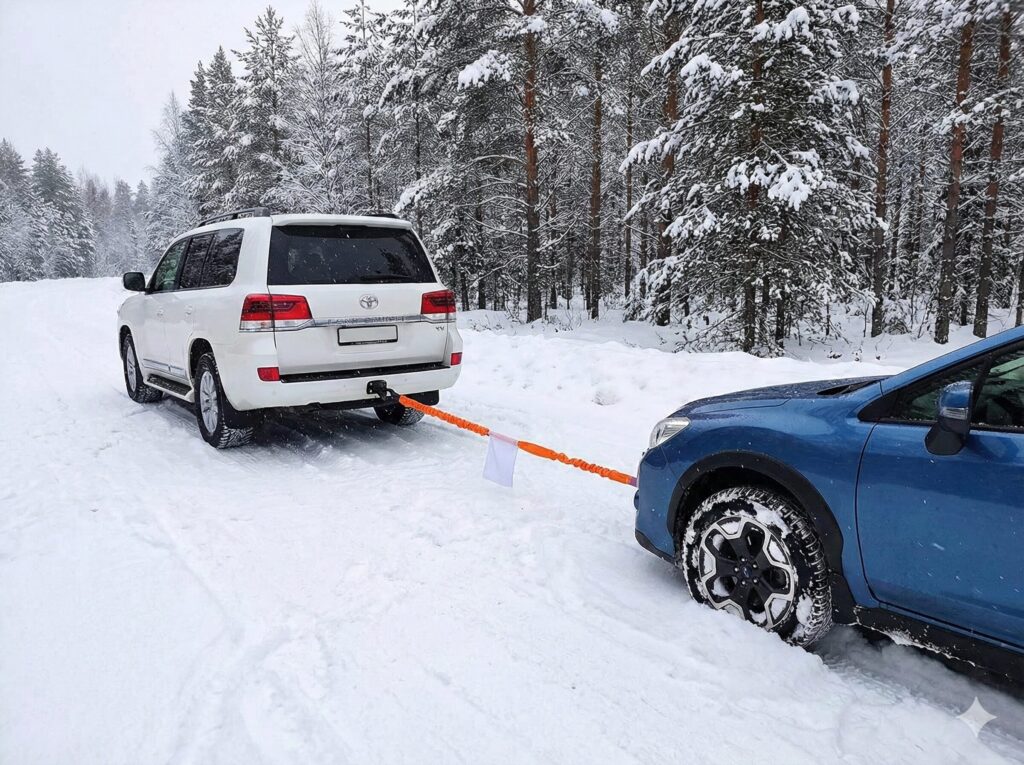
When towing, attach a cloth to the middle of the rope
A cloth placed on the rope serves two purposes.
The first purpose is to warn others around you.
Especially during the day, the rope itself can be thin and blend into the background, so the cloth improves visibility.
As a rule, attach it so it hangs down near the center of the rope.
There’s no strict requirement for size or shape, but it must be visible from a distance.
Also, at night, you must use lights and hazard flashers.
The second purpose is as a buffer.
During towing, if the hook engagement is insufficient or there is an issue with how the hook is installed, it can come off and become dangerous.
Because the rope is under tension, if a hook comes off, it can whip violently toward the side that is still attached.
In that moment, the cloth placed in the middle acts as a buffer, helping reduce damage even if it contacts a vehicle.
Understand this not as a formality, but as a measure to prevent real-world danger.
No sudden starts or hard acceleration
When towing, you must not drive as if it were normal driving.
Any abrupt maneuver is dangerous.
Pay special attention to the following.
- Sudden starts
- Hard braking
- Abrupt steering inputs
The towed vehicle’s engine may be off, which can significantly reduce braking performance.
The lead vehicle should always drive assuming “the car behind won’t stop easily”.
What beginners should look for in a towing rope
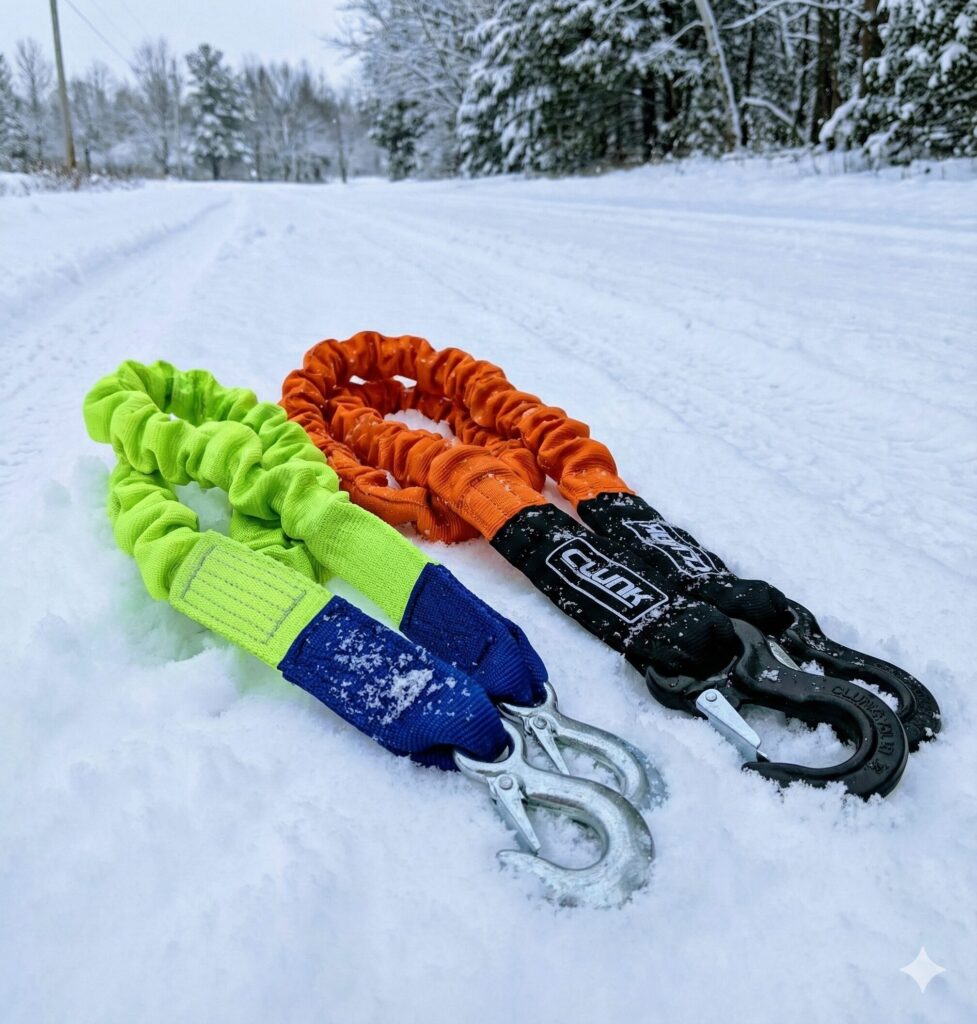
Bottom line: beginners should choose a towing rope that meets the following conditions.
- Working load rating: at least 2x the vehicle’s weight
- With hooks or shackles
- A highly visible color
- Includes a white flag/cloth, or allows you to attach one
If you choose only based on price, it’s very common to end up with something that “doesn’t really work when you actually need it.”
In the next section, we’ll introduce recommended towing ropes.
Recommended towing ropes by vehicle type
Recommended towing ropes for kei cars and small cars
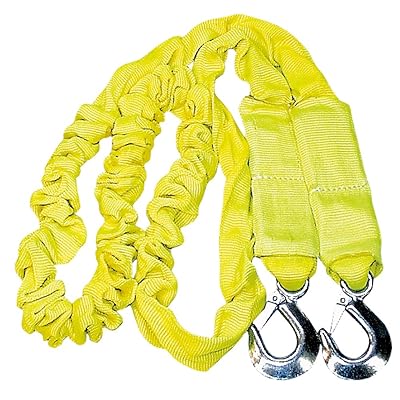
Stretchy Towing Rope GR-112

 ポチップ
ポチップ
A classic elastic model that’s easy for beginners to handle.
YAC’s “Stretchy Towing Rope GR-112” is a 2-ton-rated elastic rope designed for kei cars and compact cars.
It’s designed to absorb shock at takeoff and when load is applied, making it easier to use even for beginners who aren’t used to towing.
It also has a proven distribution track record as a domestic Japanese car-accessory brand, and the Japanese labeling and instructions are easy to understand—another reassuring point.
Its compact storage form makes it suitable to keep in your vehicle as an emergency backup “just in case.”
Recommended for
- Kei car and compact car owners
- People buying their first towing rope
- Those who want the easiest-to-handle model possible
| Product name | Stretchy Towing Rope GR-112 |
|---|---|
| Manufacturer | YAC |
| Working load | Approx. 2t |
| Breaking strength | Up to 2.3t |
| Safe load | Up to 2.0t |
| Type | Elastic / stretch type |
| Length (retracted) | Approx. 2m |
| Length (extended) | Approx. 4m |
| Target vehicle gross weight | Under 1.5t |
| Other | Includes a white flag |
Daijikogyo Meltec Stretch Towing Rope 2t RP-20
 ポチップ
ポチップ
A staple elastic tow rope from the domestic brand Meltec.
Daijikogyo (Meltec)’s “Stretch Towing Rope RP-20” offers solid, no-frills performance for emergency towing of kei-to-small cars.
Because it’s an elastic type, it helps prevent a sudden spike of load at takeoff, giving you more control even the first time you use a tow rope.
It also clearly states “2-ton class compatible,” making it easier for beginners to judge whether it’s suitable for their vehicle.
As something to keep in the car for emergencies, it’s a practical choice: “meets the requirements without being overkill.”
Recommended for
- Kei car and compact car owners
- People buying their first towing rope
- Those who want reliable performance for everyday preparedness
| Product name | Stretch Towing Rope 2t RP-20 |
|---|---|
| Manufacturer | 大自工業(Meltec) |
| Working load | Gross weight 2t |
| Breaking strength | Approx. 3.3t |
| Safe load | Not specified |
| Type | Elastic / stretch type |
| Length (retracted) | Approx. 2m |
| Length (extended) | Approx. 4m |
| Target vehicle gross weight | Gross weight 2t |
| Other | Includes a white flag |
Recommended towing ropes for midsize cars
Daijikogyo Meltec Stretch Towing Rope 3.3t RP-3T
 ポチップ
ポチップ
A classic model for midsize cars if you want a bit of extra margin.
Meltec’s “Stretch Towing Rope 3.3t RP-3T” is an elastic type rated for the 3.3-ton class.
Even when a lot of force would normally hit the rope at takeoff, the rope stretches to absorb shock in stages, helping reduce that “hard jolt the moment you pull” feeling.
Midsize cars often run into trouble when loaded with passengers and cargo, and the vehicle’s gross weight can end up heavier than expected.
In that sense, the “Stretch Towing Rope 3.3t RP-3T” is a practical choice for midsize-car owners who want extra headroom.
“You won’t use it often, but when you do, you don’t want to mess it up.”
For that kind of user, it’s a reassuring one to have.
Recommended for
- Those who want to minimize the jolt at takeoff as much as possible
- Those who want a reliable product from a domestic manufacturer
- Anyone considering buying a towing rope as emergency preparedness
| Product name | Stretch Towing Rope 3.3t RP-3T |
|---|---|
| Manufacturer | 大自工業(Meltec) |
| Working load | Gross weight 2t |
| Breaking strength | Approx. 3.3t |
| Safe load | Not specified |
| Type | Elastic / stretch type |
| Length (retracted) | Approx. 2m |
| Length (extended) | Approx. 4m |
| Target vehicle gross weight | Gross weight 2t |
| Other | Includes a white flag |
Recommended towing ropes for minivans and SUVs
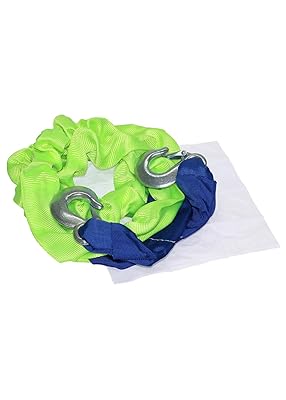
Daijikogyo Meltec Stretch Towing Rope 6.3t RP-6T
 ポチップ
ポチップ
A high-strength model for minivans and SUVs, so you don’t worry about “not enough.”
With minivan/SUV classes, the scary part isn’t “whether it can move”—it’s that, at the very first moment you start pulling, the rope can see more force than expected.
The heavier the vehicle, the bigger the takeoff shock and rolling resistance, and a rope without enough spec margin will feel risky.
Meltec’s “Stretch Towing Rope 6.3t RP-6T” is rated for real-world minivan/SUV weight: breaking strength approx. 6.3t, allowable vehicle gross weight 3t.
Because it’s an elastic type, it also helps soften that “hard jolt” at takeoff and makes it easier for beginners to maintain control.
As emergency preparedness, it’s a reassuring rope to have.
Recommended for
- Minivan and SUV owners
- Those who want to reduce the shock with an elastic type
- Those who prefer a domestic manufacturer
| Product name | Stretch Towing Rope 6.3t RP-6T |
|---|---|
| Manufacturer | 大自工業(Meltec) |
| Working load | Gross weight 3t |
| Breaking strength | Approx. 6.3t |
| Safe load | Not specified |
| Type | Elastic / stretch type |
| Length (retracted) | Approx. 2m |
| Length (extended) | Approx. 4m |
| Target vehicle gross weight | Gross weight 3t |
| Other | Includes a white flag |
Recommended towing ropes for off-road vehicles
Hashiken SOFT CAR ROPE H SERIES
 ポチップ
ポチップ
A soft-shackle integrated tow rope that doesn’t use metal hooks.
Hashiken’s “SOFT CAR ROPE H SERIES” is a towing rope designed around that concern, featuring a soft-shackle integrated design.
Because it doesn’t use metal hooks and instead cinches with the rope itself, it’s less likely to damage the vehicle even if you make a mistake with the attachment point, and it helps reduce stress on the tow point.
Also, thanks to its elastic construction, it absorbs impacts progressively even during takeoff or when rolling resistance is high, making it easier to avoid situations where “a sudden strong force hits all at once.”
It’s designed to give you more control in situations like snowy roads or when recovering from a stuck vehicle, where the car may suddenly break free and move.
“I need strength, but I want to minimize the risk of damaging the car.”
For people who want to choose a towing rope with that mindset, the H SERIES can be seen as a practical option that prioritizes peace of mind.
Recommended for
- People who enjoy off-road driving
- Those who may need to tow larger vehicles
- Those expecting use in steep, demanding locations
| Product name | SOFT CAR ROPE H SERIES |
|---|---|
| Manufacturer | 橋研 |
| Working load | Up to 16t |
| Breaking strength | 20t |
| Safe load | Not specified |
| Type | Elastic / stretch type |
| Length (retracted) | Approx. 2.1m |
| Length (extended) | Approx. 5m |
| Target vehicle gross weight | Gross weight 16t |
| Other | Includes a white flag |
If using a tow rope is difficult, contact “Garage Red Line / public services / your insurance road service”

If the vehicle still won’t move even after trying the methods above, pushing it further can lead to vehicle damage or a secondary accident.
In that case, deciding to call a professional roadside assistance service is often the safest and most reliable option.
Contact Garage Red Line
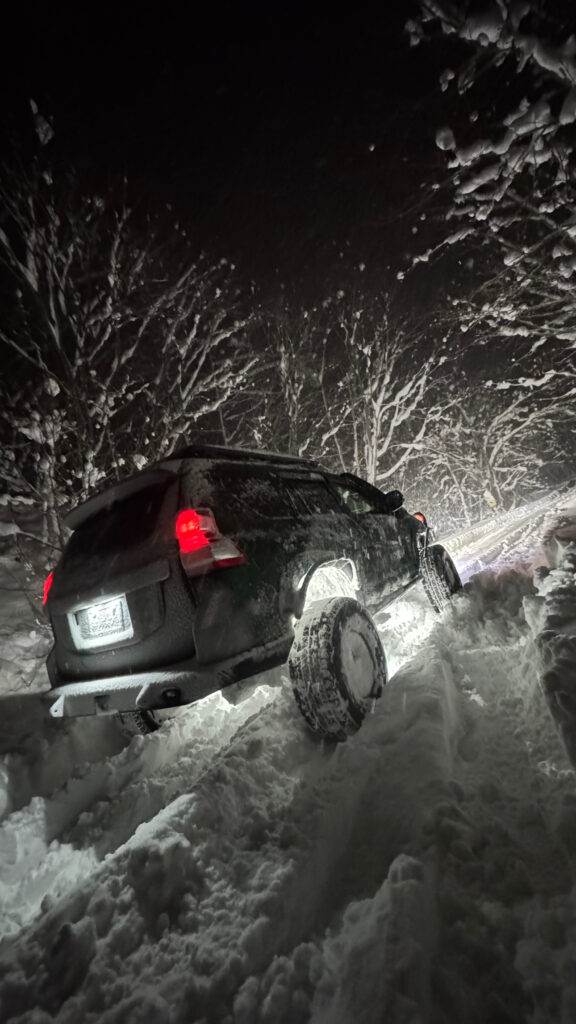
Staff with real-world experience driving on off-road terrain and snowy roads will assess the situation and determine a recovery/towing method that won’t damage your vehicle.
Forced pulls or brute-force towing can place heavy stress on the bumper, suspension, and drivetrain.
Being able to judge “where to apply force” and “when not to move it yet” directly leads to safer recovery.
A pro who knows snowy-field recoveries will provide the best on-site response for your situation.
Contact JAF (Japan Automobile Federation) [#8139]
If you’re a JAF member, they can also assist with getting unstuck (being stranded in snow).
- Nationwide number: #8139
- Callable from smartphones and mobile phones
- For members, certain assistance services are free within set limits
Non-members can also use the service, but fees will apply depending on the work required.
To provide accurate location information, it helps to check nearby landmarks or the road name before calling.
Use the “roadside assistance” included with your auto insurance
Many auto insurance policies include free roadside assistance separate from JAF.
- Snow recovery (stuck assistance)
- Towing / pull-out recovery
- On-site basic support
In many cases, these services are included, and the advantage is that you can get help simply by contacting your insurance company directly.
Coverage and usage limits vary by policy, so knowing “what my insurance covers” ahead of time helps you stay calm when something happens.
Frequently Asked Questions (Q&A)
- Q1. Can I attach a towing rope anywhere?
-
No. Always attach it only to the designated towing points engineered into the vehicle.
Attaching it to the bumper, suspension, control arms, near the muffler/exhaust, etc. can cause damage or accidents.
The most reliable method is to confirm the location specified in the owner’s manual. - Q2. Which is correct: front or rear towing point?
-
In general, attach it to the rear of the pulling vehicle and the front of the vehicle being towed.
Some vehicles have towing points at both ends, but
the key is choosing a point that won’t apply an unnatural load relative to the direction of travel. - Q3. Do I really need a white cloth?
-
Yes, you do.
Under Japan’s Road Traffic Act, you must attach a white cloth (at least 30 cm square) to the center of the rope.
This rule is to improve visibility and prevent collisions with following vehicles. - Q4. How fast should I drive while towing?
-
There’s no single fixed number—it depends on the situation—but drive as slowly and carefully as possible.
Avoid sudden starts and hard braking, and keep the rope under constant tension. - Q5. Can a car with a dead engine be steered and braked while being towed?
-
Steering and braking are possible, but
power steering and brake assist may not work.
Because you may need much more force than usual, use extreme caution.
Summary
The single most important thing when using a towing rope is attaching it to the correct point, in the correct way.
If you judge by appearance and attach it to the bumper or suspension, it can lead to vehicle damage or an accident.
Key takeaways from this article are as follows.
- Always attach the tow rope to the OEM designated tow point
- For both front and rear, confirm the location in the owner’s manual
- Keep the rope under tension and avoid abrupt maneuvers
- Don’t skip rules and safety measures, such as attaching a white cloth
- Choose a rope with a working load rating that provides enough margin for your vehicle’s weight
If you can reproduce the correct attachment method while looking at the photos, even beginners can respond calmly.
To be prepared, having a reliable towing rope ready in advance ultimately leads to safer outcomes.
However, towing is still only an emergency, temporary measure.
If you feel even a little unsure, choosing to use roadside assistance rather than forcing it is also important.
Garage Red Line(ガレージレッドライン)では費用感のご相談だけでも承っております。
豊富な知識と経験をもとに専門スタッフがお客様に最適なプランをご提案。
どんなことでも構いませんので、まずはお気軽にお問い合わせください。