A tow rope is a reliable tool when you’re in a pinch, but choosing the wrong one can lead to serious danger.
It’s not uncommon for people to pick one based on price or looks without really knowing “how many tons to choose,” “how long it needs to be,” or “whether it’s legally compliant.”
Especially for beginners, it can be hard to tell the difference between terms like breaking strength and working load limit (WLL), which makes it difficult to judge whether a rope truly matches their vehicle.
In this article, to help first-time buyers avoid confusion, we’ll walk through key points like load rating, breaking strength, length, type, and legal considerations in order, and we’ll introduce realistic selection tips by vehicle size plus specific product examples.
Even if you just want to “keep one in the car for now” or “only know the minimum conditions to use it safely,” by the end you’ll be able to choose a tow rope that fits your vehicle.
Garage Red Line(ガレージレッドライン)では費用感のご相談だけでも承っております。
豊富な知識と経験をもとに専門スタッフがお客様に最適なプランをご提案。
どんなことでも構いませんので、まずはお気軽にお問い合わせください。
監修者
(株)STAY GOLD:Garage Red Line 代表 久保田 将平

Garage Red Line創業者。幼少期から車に親しみ、板金・カスタムの現場で技術を磨く。
2018年に独立し、現在は自社で多様なカスタム・整備に対応。TRY-XやXCT-Dualをはじめとしたレース・クロカン優勝経験を活かし、実践的な知識で監修を担当。
現在もドライバーとして活動している。
久保田 将平
この記事を書いた人
記事ディレクター/ライター/フォトグラファー・清水

カメラの専門学校で撮影技術と作品制作を学んだのち、車業回で勤務しながらアウトドア撮影を中心に活動。
現在はGarage Red Line Styleをはじめとしたさまざまな媒体で執筆。
初心者にも伝わる構成づくり・検索意図設計・文章作成を活かし、企画・構成・執筆・改善まで一貫して担当している。
清水
3 Ways to Get Your Car Out After It’s Buried in Snow: Plus “Don’t Do This” Mistakes Explained
If you stick to these conditions, you won’t fail at choosing a tow rope
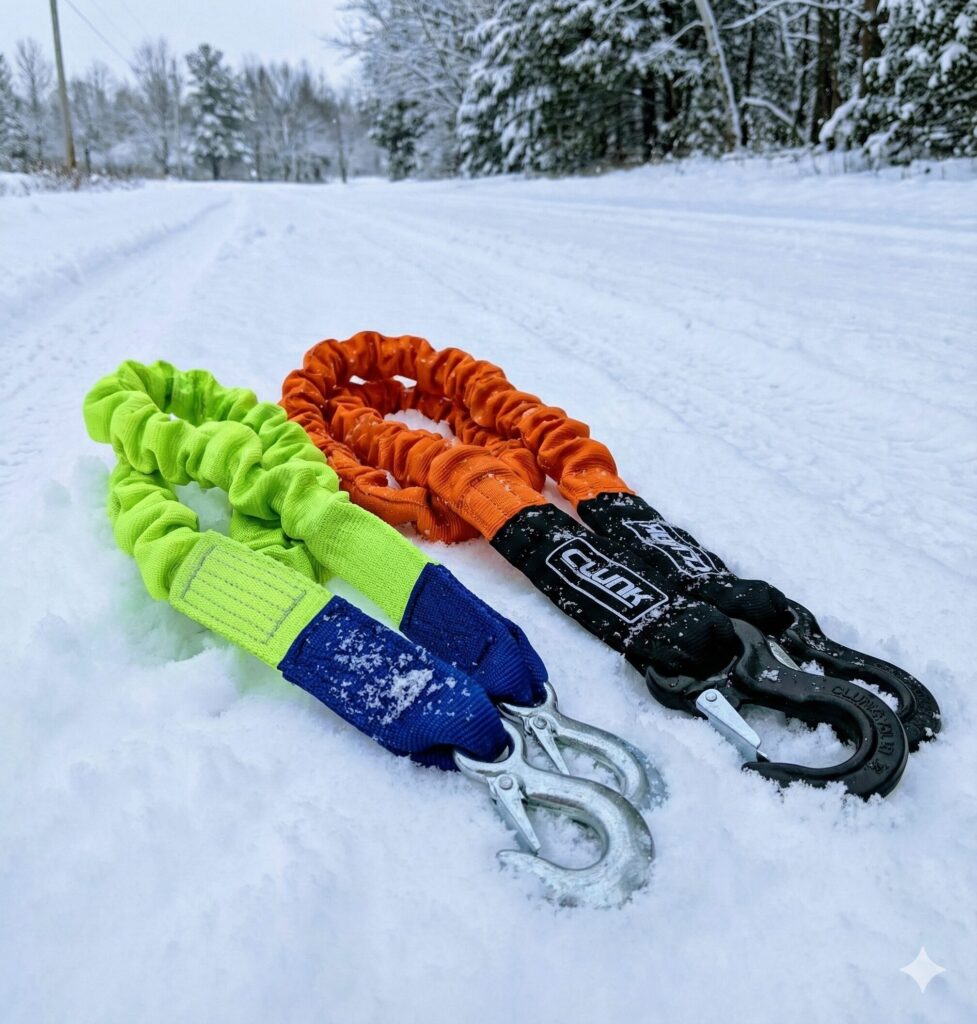
In short, the criteria beginners should check when choosing a tow rope can be boiled down to four points: “load rating,” “length,” “type,” and “whether it includes a flag/cloth”.
With tow ropes, performance differences aren’t obvious from price or appearance, and product descriptions are often packed with technical jargon.
That’s why choosing based on “looks strong” or “it’s cheap” can cause the rope to snap or damage the vehicle during use.
Also, tow ropes are most often used in emergencies—there’s rarely time to go back and choose again.
In the following sections, we’ll organize practical criteria you can use to make a safe, realistic decision.
What is a tow rope, and what is it used for?
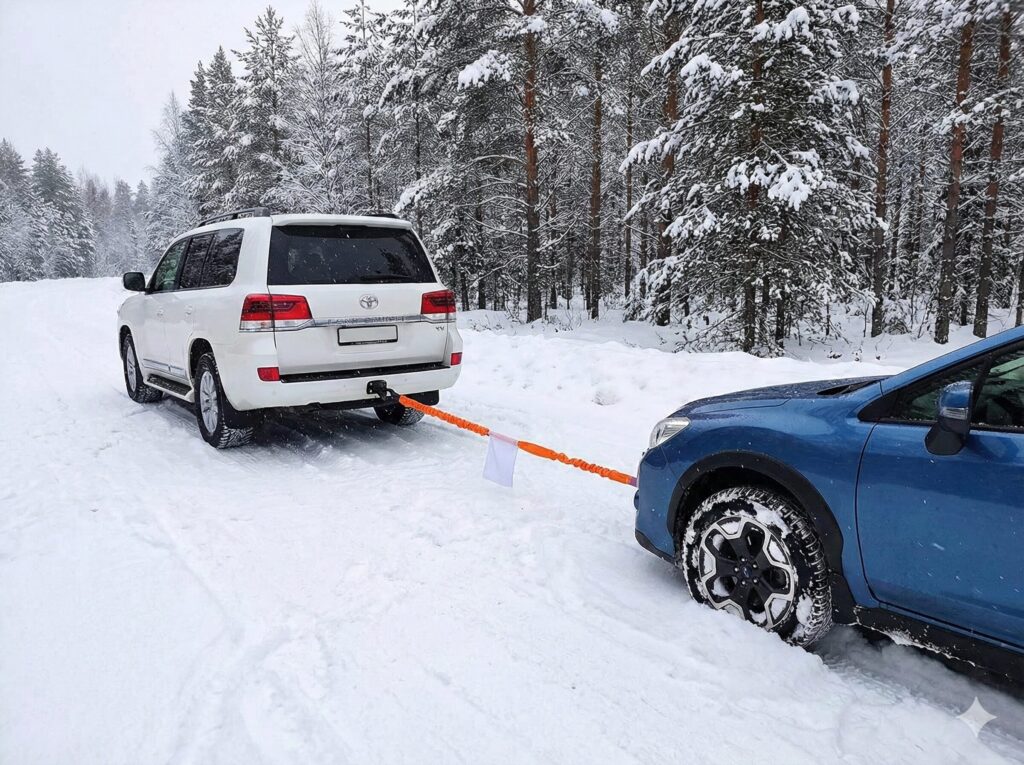
Common situations where you need a tow rope
- Safety gear used to pull and move a disabled vehicle
- Common scenarios include breakdowns and getting stuck on snowy roads
- Not intended for long-distance towing or high-speed driving
A tow rope is a tool used to pull and move a vehicle that can no longer drive under its own power using another vehicle.
Rather than a “leisure item,” it’s best understood as emergency safety equipment for dealing with trouble.
Typical scenarios include a dead battery, engine trouble that leaves the car immobile, or getting stuck (snow/mud bogging).
On snowy roads in particular, it’s common for tires to spin and leave you unable to get out on your own.
In situations like that, if another vehicle can help nearby, a tow rope can be used to move the car a short distance.
On the other hand, it is not designed for long-distance towing or highway speeds.
It’s an emergency measure—“to get out of the immediate situation” and “to move to a safe spot.”
If you don’t understand that premise, it leads to unsafe use.
How it differs from a tow truck (recovery) and what to watch out for
- Towing with a rope is very different from professional recovery in purpose and safety
- Usable situations are limited
- Driver mistakes can easily lead to accidents
Moving a vehicle using a tow rope is fundamentally different from professional towing/recovery.
Professional recovery uses dedicated vehicles and equipment, following legal and safety standards to transport the vehicle.
A tow rope, by contrast, is only a simple rescue method between regular vehicles.
If you ignore that difference and try to pull the car long distances or use a tow rope on busy roads, the risk rises sharply.
Also, vehicle control while towing is difficult—mistakes with braking or signaling can cause rear-end collisions or fishtailing.
That’s why you need to understand that a tow rope is “a tool that only works in limited situations.”
To use it safely, meeting the load rating and following the rules is a prerequisite.
How to think correctly about load rating and breaking strength

A clear breakdown of the difference between load rating and breaking strength
- Breaking strength and load rating mean different things
Breaking strength is the limit where it snaps; load rating indicates the range considered safe for use (WLL). - Always confirm what standard the number refers to
If it’s only breaking strength—or if it’s WLL/safe working load or “rated vehicle weight”—choosing without checking can leave you with little safety margin. - What matters is having enough margin over your vehicle weight
Consider starting loads and surface resistance; don’t judge by a big number alone—judge by conservative safety margin.
The most important part of choosing a tow rope is understanding load rating vs. breaking strength.
Breaking strength is the maximum force at which the rope will fail (snap).
Load rating (often aligned with WLL: Working Load Limit) is a guideline for the safe range under normal use.
Depending on the product, some list only breaking strength, while others also list safe working load or “rated vehicle weight”.
So if you choose without confirming “what the displayed number actually represents,” you might end up with a rope that has less margin than you assumed.
In real towing, a large force can spike momentarily during initial pull-off or due to surface resistance.
Rather than judging by the size of the number alone, it’s important to confirm whether the rated vehicle weight or safe working load provides sufficient margin.
How to check the load rating your vehicle needs
- Use your vehicle inspection document’s “Gross Vehicle Weight” as the baseline
It accounts for passengers and cargo, making it a practical reference for towing decisions. - Matching GVW is not enough
Because of starting loads and surface resistance, a spec with no margin can be dangerous. - Choose based on having margin above your GVW
Especially for snow and stuck recovery, selecting conservatively with extra margin is critical.
To think about the required load rating, you first need to know how heavy your vehicle is.
A safe way is to check the “gross vehicle weight” listed on your vehicle inspection document.
Gross vehicle weight reflects the vehicle with occupants and cargo, making it a useful reference when considering towing loads.
As a baseline, choose a rope whose breaking strength / rated vehicle weight is set with ample margin over your vehicle’s gross vehicle weight.
However, because large loads can spike momentarily during initial pull-off and due to road resistance, a number that only matches your gross vehicle weight is not sufficient.
Especially in snow or when the vehicle is stuck, forces can exceed expectations.
If you check with the mindset of “do I have margin above my gross vehicle weight,” it becomes much easier to avoid unsafe choices.
How many meters should your tow rope be?

3–5 m is the baseline, but some situations require more length
- Too short increases shock transfer
Loads hit directly during starts and stops, raising the risk of a rear-end collision. - A moderate length balances control and safety
It’s easier to monitor tension and more visible to surrounding traffic on public roads.
For beginners, a tow rope length of around 3–5 m is a safe rule of thumb, though there are situations where more length can be useful.
Within this range, the vehicles won’t be too close, while still maintaining a distance where communication is manageable.
If the distance is too short, shock loads transfer more directly during starts and stops.
The following vehicle has less time to react to the lead vehicle, increasing the risk of a rear-end collision.
With a moderate length, it becomes easier to operate while checking rope tension.
Also, for use on public roads, around 3–5 m is easier for surrounding drivers to notice, making sudden cut-ins and abrupt lane changes less likely.
Given beginner handling and ease of use, 3–5 m is a realistic choice.
Risks of being too short or too long
- Too short increases the risk of a rear-end collision
Following distance shrinks, and small braking timing differences can cause an accident. - Too long increases shock and trouble
Slack can create sudden shock loads, and the rope can drag, snag, or get caught. - Prioritize a manageable length for safety
Rather than choosing extra length for edge cases, an appropriate length with fewer risks matters most.
If the tow rope is too short, the vehicles get extremely close, and even slight braking mismatches can cause a rear-end collision.
Conversely, if the rope is too long, it tends to develop slack, which can create a sudden shock load when pulling off.
It also becomes easier for the rope to contact the ground, increasing the chance of snagging or entanglement.
At intersections or on narrow roads, it can also obstruct other vehicles.
Rope length directly affects safety.
Rather than choosing a long rope for special scenarios, it’s important to prioritize a length that’s easy to handle and carries lower risk.
Tow rope types and their characteristics
Stretchy types (nylon / elastic) and who they’re for
- Absorbs shock and is easier for beginners to handle
It softens load spikes at pull-off and reduces stress on the vehicle and rope. - Good for snow, mud, and situations with wheelspin
Because it absorbs repeated shocks, it’s effective for stuck recovery. - Watch for changes in distance between vehicles
Because it stretches, movement is less obvious; confirm signals and the pull-off method in advance.
Stretchy tow ropes are made from materials that can extend and contract to some degree under load.
Common examples include nylon ropes and ropes woven with elastic material.
The biggest feature is their ability to absorb shock when pulling off or when load spikes hit.
Because of this, they tend to reduce stress on the vehicle and rope even when force is applied suddenly, making them relatively beginner-friendly.
In snow or mud where wheelspin is likely, shocks can occur repeatedly, so the advantages of a stretchy rope really matter.
That said, because it stretches, it can be harder to judge changes in following distance, making timing tricky if you’re not used to it.
It’s important to confirm signaling and how you’ll pull off before you start.
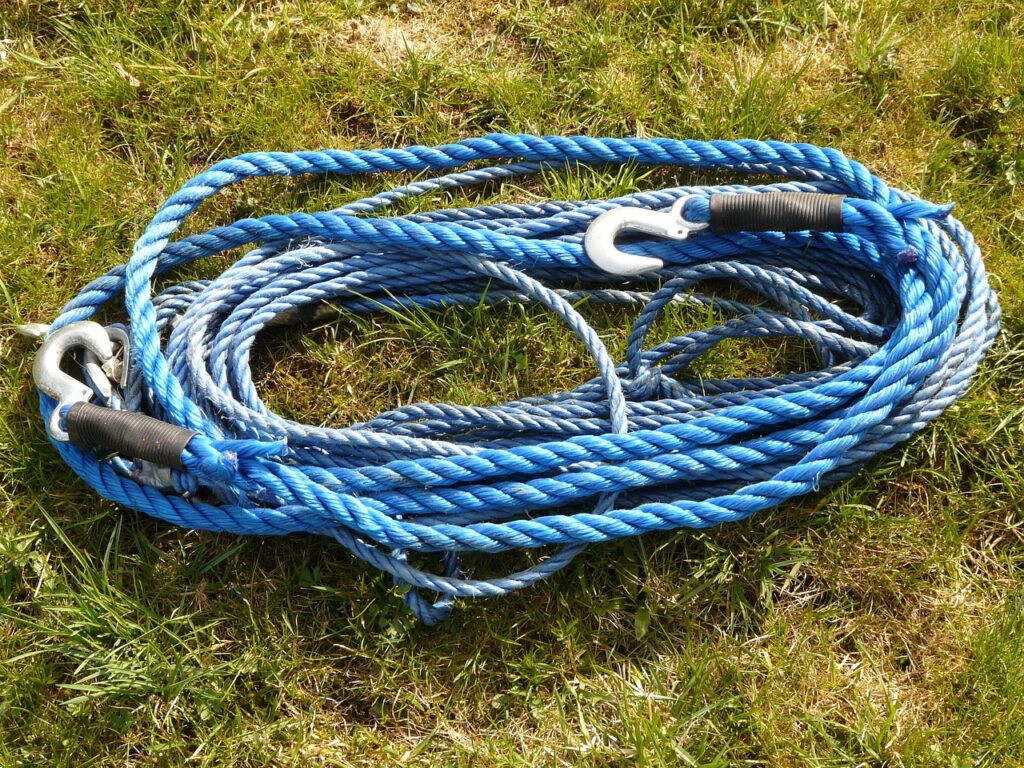
Non-stretch types (wire / strap) and what to watch out for
- No elasticity—force transfers directly
Vehicle movement transmits as-is, making timing easier to read. - Shock loads tend to be larger
During pull-off or over bumps, loads spike and can stress the chassis and mounting points. - Requires experience and judgment
Risk is higher if you’re not used to it; it’s better suited to people with towing experience.
Non-stretch tow ropes include wire cables and fabric tow straps.
They have little to no elasticity, so force transfers directly.
Because vehicle movement transfers through the rope as-is, it can be easier to understand timing—that’s the advantage.
However, if force spikes suddenly during pull-off or over bumps, that shock is transmitted directly to the vehicles and the rope.
If you’re not used to handling it, unexpected loads can occur and may damage the vehicle body or attachment points.
For that reason, non-stretch types are better suited to people with towing experience or situations where you can accurately judge conditions.
Critical safety rules you must know (Road Traffic Act)

Minimum rules required under the Road Traffic Act
If you use a tow rope to move a vehicle, following traffic rules (the Road Traffic Act) is non-negotiable.
Towing isn’t something you can do freely—conditions exist to ensure safety.
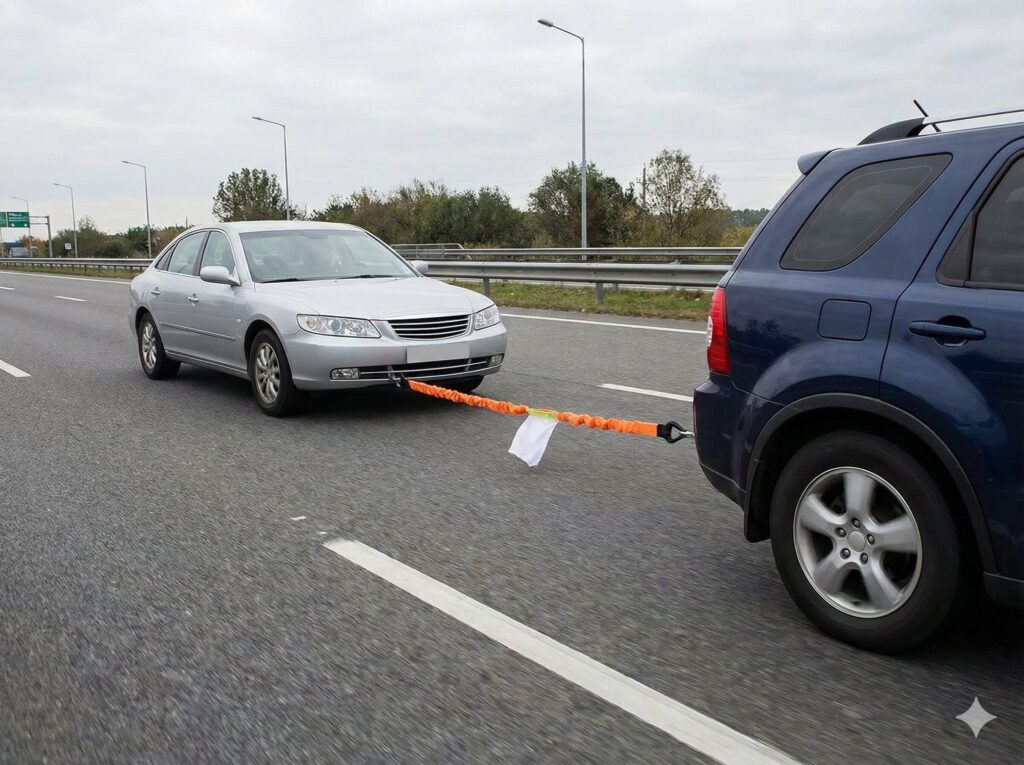
One representative requirement is making it clearly visible to others that the two vehicles are in a towing situation.
This is meant to warn following and oncoming traffic and prevent rear-end collisions or cut-ins.
Also, the towed vehicle must have a driver inside who can steer and brake.
If you tow without following these rules, it’s not only dangerous—depending on the circumstances, it may also be treated as a violation.
A tow rope is useful, but use it within legal boundaries.
Why you need a flag/cloth
The cloth attached mid-rope has two purposes.
The first is visibility for surrounding traffic.
Especially in daytime, the rope itself can be thin and blend into the background, so the cloth helps improve visibility.
The standard approach is to attach it so it hangs down near the middle of the rope.
There’s no strict specification for size or shape, but it must be clearly visible from a distance.
Also, at night, using lights and hazard flashers is essential.
The second purpose is to act as a damper/weight.
During towing, if the hook engagement is weak or there’s an issue with how the hook is attached, it can come off and become dangerous.
Because the rope is under tension, if a hook comes loose, it can whip violently toward the side that’s still attached.
In that moment, the cloth placed in the center acts as a damper, helping reduce impact damage even if it contacts a vehicle.
It’s not just a formality—think of it as a practical measure to reduce real risk.
Dangerous mistakes beginners often make
A common beginner mistake is pulling off without any pre-tow communication.
With towing, you must decide start/stop/turn timing in advance and share clear signals—otherwise accidents can happen.
Sudden acceleration or hard braking is also extremely dangerous.
It can create an instant spike in force on the rope, leading to snapping or vehicle damage.
You should also avoid towing in heavy traffic or in places with poor visibility.
A tow rope is only usable in limited situations, and when you can’t secure safety, it’s better to choose a different option rather than forcing it.
Recommended tow ropes for kei cars and compact cars
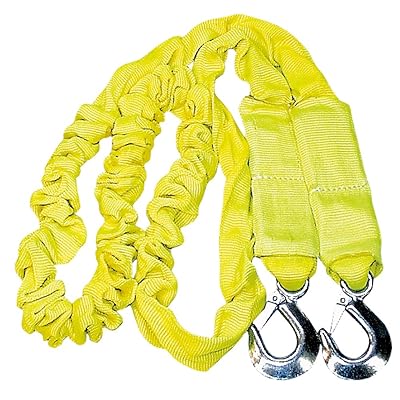
Nobiru Nobiru Tow Rope GR-112

 ポチップ
ポチップ
A classic stretch-type model that’s easy to handle even for beginners.
YAC’s “Nobiru Nobiru Tow Rope GR-112” is a 2-ton stretch-type model designed for kei cars and compact cars.
It helps absorb shock at pull-off and during load spikes, making it easier to handle even if you’re new to towing.
As a well-distributed Japanese car-accessories brand, its labeling and instructions are easy to understand, which can be reassuring.
Its compact storage size makes it a good “just in case” item to keep in the vehicle.
Recommended for
- People who drive a kei car or compact car
- People buying their first tow rope
- People who want the easiest-to-handle option
| Product name | Nobiru Nobiru Tow Rope GR-112 |
|---|---|
| Brand | YAC |
| Load rating | Approx. 2t |
| Breaking strength | Up to 2.3t |
| Safe working load | Up to 2.0t |
| Type | Stretch type |
| Length (retracted) | Approx. 2m |
| Length (extended) | Approx. 4m |
| Rated gross vehicle weight | Under 1.5t |
| Other | Includes white flag |
Daisaku Kogyo Meltec Stretch Tow Rope 2t RP-20
 ポチップ
ポチップ
A standard stretch-type tow rope from the Japanese brand Meltec.
Daisaku Kogyo (Meltec)’s “Stretch Tow Rope RP-20” offers solid, no-frills performance for emergency towing of kei to small-class vehicles.
Because it’s a stretch type, it helps reduce sudden load spikes at pull-off, giving you more operational margin even if it’s your first time using a tow rope.
It’s also beginner-friendly because labeling is easy to understand and it clearly states “2t class compatible,” which makes it easier to judge if it fits your vehicle.
As a “just in case” item to keep in your car, it’s a realistic choice: it meets the necessary conditions without being overkill.
Recommended for
- People who drive a kei car or compact car
- People buying their first tow rope
- People who want reliable performance for everyday preparedness
| Product name | Stretch Tow Rope 2t RP-20 |
|---|---|
| Brand | Daisaku Kogyo (Meltec) |
| Load rating | Gross weight 2t |
| Breaking strength | Approx. 3.3t |
| Safe working load | Not listed |
| Type | Stretch type |
| Length (retracted) | Approx. 2m |
| Length (extended) | Approx. 4m |
| Rated gross vehicle weight | Gross weight 2t |
| Other | Includes white flag |
Recommended tow ropes for mid-size vehicles
Daisaku Kogyo Meltec Stretch Tow Rope 3.3t RP-3T
 ポチップ
ポチップ
A standard pick for mid-size vehicles when you want extra margin.
Meltec’s “Stretch Tow Rope 3.3t RP-3t” is a 3.3t-class stretch-type model.
Even when loads spike at pull-off, the rope stretches to absorb shock, helping reduce that “hard jolt right when you pull” feeling.
Mid-size vehicles often run into trouble while carrying passengers and cargo, and their gross vehicle weight can be heavier than expected.
In that sense, the “Stretch Tow Rope 3.3t RP-3t” is a realistic option for mid-size drivers who want extra safety margin.
“You won’t use it often, but when you do, you don’t want to mess it up.”
For mid-size vehicle owners, this is a reassuring choice.
Recommended for
- People who want to reduce pull-off shock as much as possible
- People who want something reliable from a Japanese manufacturer
- People looking to buy a tow rope for emergency preparedness
| Product name | Stretch Tow Rope 3.3t RP-3T |
|---|---|
| Brand | Daisaku Kogyo (Meltec) |
| Load rating | Gross weight 2t |
| Breaking strength | Approx. 3.3t |
| Safe working load | Not listed |
| Type | Stretch type |
| Length (retracted) | Approx. 2m |
| Length (extended) | Approx. 4m |
| Rated gross vehicle weight | Gross weight 2t |
| Other | Includes white flag |
Recommended tow ropes for minivans and SUVs
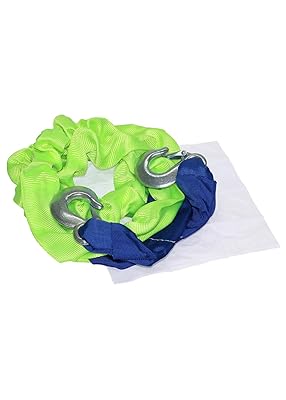
Daisaku Kogyo Meltec Stretch Tow Rope 6.3t RP-6T
 ポチップ
ポチップ
A high-strength model that removes “what if it’s not enough?” anxiety for minivans and SUVs.
With minivans and SUVs, the scary part isn’t “can it move?”—it’s that the rope can see more force than expected in the first instant of pulling.
Because the vehicle is heavier, starting shock and road resistance increase, and a rope with little margin can leave you uneasy.
Meltec’s “Stretch Tow Rope 6.3t RP-6T” is rated with real-world minivan/SUV weight in mind: breaking strength approx. 6.3t, usable gross vehicle weight 3t.
It’s also a stretch type, so it helps soften that “hard jolt” at pull-off and makes it easier for beginners to keep some operational margin.
As emergency preparedness, it’s a solid, reassuring choice.
Recommended for
- People who drive a minivan or SUV
- People who want to reduce shock with a stretch type
- People who prefer a Japanese manufacturer
| Product name | Stretch Tow Rope 6.3t RP-6T |
|---|---|
| Brand | Daisaku Kogyo (Meltec) |
| Load rating | Gross weight 3t |
| Breaking strength | Approx. 6.3t |
| Safe working load | Not listed |
| Type | Stretch type |
| Length (retracted) | Approx. 2m |
| Length (extended) | Approx. 4m |
| Rated gross vehicle weight | Gross weight 3t |
| Other | Includes white flag |
Recommended tow ropes for off-road vehicles
Hashiken SOFT CAR ROPE H SERIES
 ポチップ
ポチップ
A soft-shackle integrated tow rope that avoids metal hooks.
Hashiken’s “SOFT CAR ROPE H SERIES” is a soft-shackle integrated tow rope designed with those concerns in mind.
Because it doesn’t use metal hooks and instead secures with the rope itself, it’s less likely to scratch or damage the vehicle even if you choose the wrong attachment point, and it can help reduce stress on the recovery points.
Its elastic structure also helps absorb shock progressively during pull-off and in high-resistance situations, making it easier to avoid “sudden heavy load” moments.
Even in snow or stuck recovery where the vehicle can suddenly break free, the design helps you maintain operational margin.
“I need strength, but I want to minimize the risk of damaging the vehicle.”
For people choosing a tow rope with that mindset, the H SERIES is a practical choice that prioritizes peace of mind.
Recommended for
- People who enjoy off-road driving
- People who may need to recover/tow larger vehicles
- People who expect to use it in steep or challenging terrain
| Product name | SOFT CAR ROPE H SERIES |
|---|---|
| Brand | 橋研 |
| Load rating | Up to 16t |
| Breaking strength | 20t |
| Safe working load | Not listed |
| Type | Stretch type |
| Length (retracted) | Approx. 2.1m |
| Length (extended) | Approx. 5m |
| Rated gross vehicle weight | Gross weight 16t |
| Other | Includes white flag |
If using a tow rope is difficult, contact “Garage Red Line / public services / insurance road assistance”

If the vehicle still won’t move after trying the methods introduced above, forcing it further can lead to vehicle damage or a secondary accident.
In those situations, choosing to contact professional road assistance is often the safest and most reliable option.
Contact Garage Red Line (ガレージレッドライン)
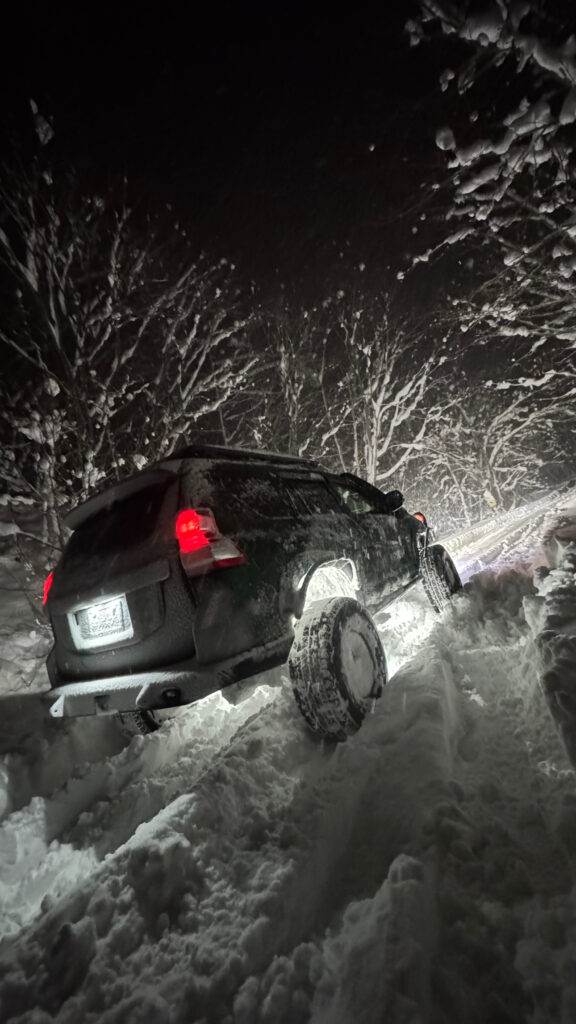
Staff with real-world experience in off-road driving and snowy conditions will assess the stuck situation and decide on the safest recovery/towing method that avoids damaging your vehicle.
Forcing a pull or yanking with brute force can put heavy stress on the bumper, suspension, and drivetrain.
Being able to judge “where to apply force” and “when you should not move the vehicle yet” directly affects safe recovery.
Pros who understand real snow-country conditions will provide the best on-site response for your situation.
Contact JAF (Japan Automobile Federation) [#8139]
If you’re a JAF member, they can also assist with getting stuck (snow-related immobilization).
- Nationwide dial: #8139
- Callable from smartphones and mobile phones
- Members can receive certain rescue services for free within set limits
Non-members can also use the service, but fees will apply depending on the work required.
To communicate your location accurately, it helps to confirm nearby landmarks and the road name before calling.
Use the “roadside assistance” included with your auto insurance
Many auto insurance policies include free roadside assistance separate from JAF.
- Stuck recovery on snowy roads
- Towing / pull-out assistance
- On-site minor support
In many cases, the above services are included, and the benefit is that you can get help simply by contacting your insurer directly.
Coverage scope and usage limits vary by contract, so knowing “what your insurance includes” ahead of time helps you stay calm when something happens.
FAQ

- Can using a tow rope be illegal?
-
In short, if you use it without meeting the required conditions, it may be judged as a violation.
Towing itself isn’t outright prohibited, but traffic rules (the Road Traffic Act) specify conditions to ensure safety.
For example, you must clearly indicate to others that the vehicles are in a towing situation, and the towed vehicle must have a driver inside who can operate it.
Attaching a white cloth mid-rope is also part of that rule set.
Don’t assume “it’s just a short move, so it’s fine.” If you can’t meet the rules, don’t force it—that’s the key.
- Can one rope work for any car?
-
For safety, it’s better to assume one rope can’t cover every vehicle.
Tow ropes have load ratings and rated gross vehicle weights. Using a rope meant for kei cars on a large vehicle is dangerous.
The larger the vehicle, the greater the force at pull-off and from surface resistance. That’s why you need to choose a rope that matches your vehicle size.
Even if your household owns multiple vehicles, it’s safest to either choose based on the heaviest vehicle or use different ropes depending on use.
- Are cheap tow ropes dangerous?
-
“Cheap = dangerous” isn’t always true, but products that lack key information carry higher risk.
In particular, watch for cases where load rating, breaking strength, or rated gross vehicle weight isn’t clearly stated.
If there’s no official information and you can’t verify what the numbers are based on, it’s hard to trust in an emergency.
Don’t judge by price alone—confirm that the necessary specs are clearly listed.
- Which should I choose: stretch type or non-stretch type?
-
For beginners, stretch types tend to be harder to mess up.
Because they absorb sudden shock at pull-off, it’s easier to maintain some margin during operation.
Non-stretch types transmit force directly, so if you’re not used to them, they can put more stress on the vehicle and rope.
Start with a stretch type, and consider other options later as you gain experience and depending on your use case.
- Should I always keep a tow rope in my car?
-
It’s not mandatory equipment, but if you drive on snowy roads or travel long distances often, keeping one in the car can be reassuring.
However, don’t just carry it and feel safe—understanding how to use it and the rules beforehand is essential.
Having it but not knowing how to use it doesn’t help.
If you’re carrying one for preparedness, reviewing the selection criteria and cautions in this article once will help you feel more confident.
Summary
A tow rope is a useful tool for emergencies, but it also carries risk if you choose or use it incorrectly.
That’s why it’s important to choose based on whether it meets the conditions for safe use, not price or appearance.
For beginners, the key points are these four:
- Do the load rating, breaking strength, and rated gross vehicle weight match your vehicle?
- Is the length appropriate (within an easy-to-handle range)?
- Do you understand the difference between stretch and non-stretch types?
- Does it include a white flag, and can you follow the legal requirements?
Most importantly, choose after clearly defining “which vehicle you’ll use it on.”
Kei cars/compact cars, mid-size cars, and larger vehicles require different strength levels, and assuming one rope can cover everything isn’t a safe approach.
Also, towing is only an emergency measure.
When you can’t ensure safety, don’t force it—choosing another method such as professional recovery is sometimes necessary.
“Best case is you never need it,” but as equipment that can dramatically change your peace of mind, consider choosing the right rope and keeping it ready.